



There are some photographs you plan.
And then there are photographs that happen only when planning, patience, discomfort, instinct, and a little bit of luck come together for a few seconds.
Against the Storm belongs to the second kind.
This image was made in the Great Indian Thar Desert, at night, during a heavy sandstorm. The wind was moving fast. Sand was everywhere. Visibility kept dropping. At times, it felt like the desert had disappeared into darkness and dust.
In that moment, photography was not just about pressing the shutter.
It was about protecting the gear, covering myself from the sand, managing the light, staying low, and still remaining aware enough to notice a small life moving on the dune.
A toad-headed agama was perched on a natural rise in the sand.
Small. Alert. Almost fragile.
But against that storm, it looked like a character in a much larger story.
Recognition
Juries have been kind to this frame:
- Jury's Choice, 35AWARDS 2026 (author page)
- Honourable Mention, Chromatic Awards 2025, Wildlife and Animals (award entry)
- Select Award, Phi Photography Awards 2025 (certificate)
The full record, alongside the other awarded frames, lives on the recognition page.
The Scene
The location was simple, but powerful.
A sand dune. Midnight. Wind. Darkness. A subject sitting slightly above the ground. And a light source placed low behind the dune.
That elevation changed everything.
Instead of lighting the agama from the front, I placed myself in line with the subject and used a backlight from behind. The light was not meant to reveal every detail. It was meant to reveal presence.
The sandstorm did the rest.
Every particle of sand caught the light. What would normally be invisible became visible. The air itself became part of the photograph. The storm was no longer just a condition I had to survive. It became the atmosphere of the image.
That is the strange beauty of wildlife photography.
Sometimes the thing making your work difficult is also the thing making the photograph possible.
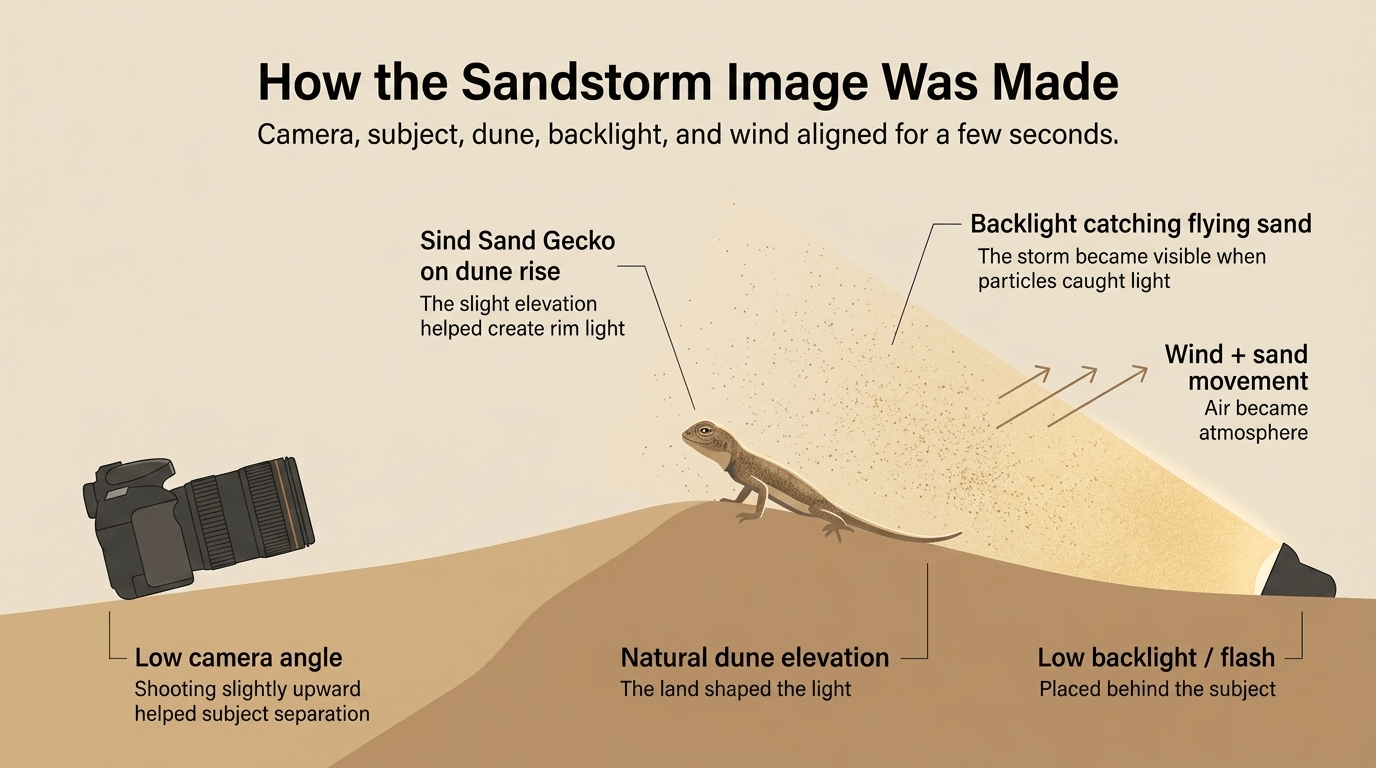 The setup was simple, but the alignment was rare: a low camera angle, an agama perched on a dune rise, and a backlight placed behind the subject. The sandstorm, which made the shoot difficult, became the very thing that gave the image its atmosphere.
Planning the Impossible
This was not a random frame.
Before going into the field, we had imagined the possibility of making an image like this. The thought was simple: if a sandstorm came, and if we found the right subject, and if the light could be placed correctly, there might be a chance to create something dramatic.
But in wildlife photography, planning only takes you halfway.
You can plan the mood.
You can plan the light.
You can plan the composition.
You can even plan the kind of behaviour or environment you are hoping for.
But you cannot command the subject.
Finding an agama in those conditions, at that hour, in the middle of the Thar, was something else entirely. The posture, the dune, the storm, the darkness, and the light all had to align.
For a few seconds, they did.
Why backlight works in wildlife photography
Backlighting is one of the most powerful tools in wildlife photography, especially when the goal is mood rather than documentation.
When we light a subject from the front, we usually reveal detail. Texture, colour, expression, pattern, surface.
But when we light from behind, we reveal shape, separation, atmosphere, and mystery.
In this photograph, the backlight created a subtle rim around the agama. It separated the subject from the dark background. More importantly, it turned the blowing sand into a visible curtain of light.
Without the storm, the light would have been interesting.
With the storm, the light became the story.
This is why the image works. The agama is not just sitting in the frame. It is standing inside an environment that feels alive.
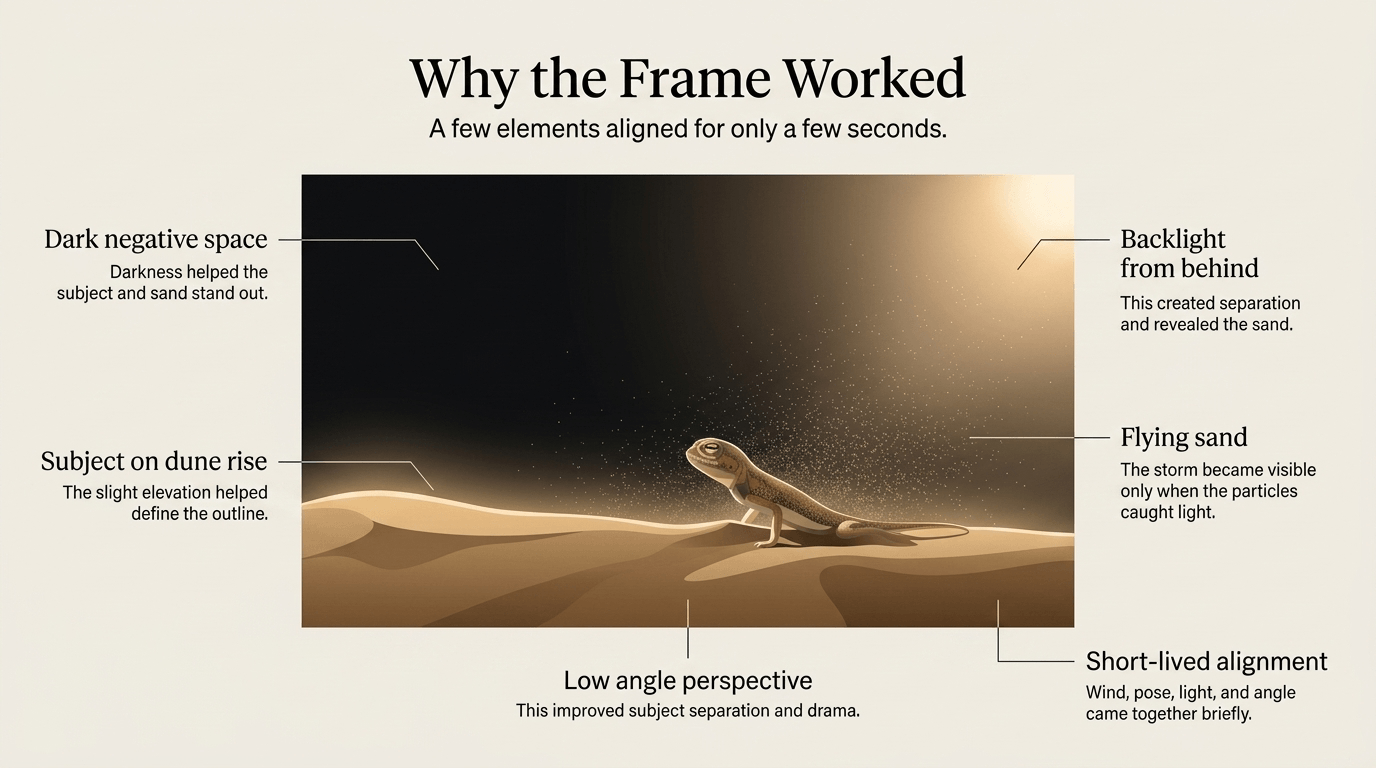 The backlight did two things: it created a rim around the agama and turned the moving sand into visible atmosphere.
Mood Through Subtraction
One of the most important lessons from this image is that a photograph does not need to show everything. It is the same discipline I wrote about in the art of subtraction, pushed to its quietest extreme.
In fact, sometimes it becomes stronger when it shows less.
The background is almost empty. The subject is small. Much of the frame is dark. There are no extra elements competing for attention. The photograph works because of restraint.
Negative space creates silence. The darkness creates tension. The small subject creates scale.
Together, they make the viewer pause.
That pause is important. In wildlife photography, we often try to get closer, fill the frame, and show more detail. There is nothing wrong with that. But sometimes, the emotional weight of an image comes from allowing the subject to remain small within its world.
Here, the agama feels alone, but not weak.
It feels small, but not lost.
It feels like life holding its ground.
The Role of Subject Placement
The placement of the agama is also a key part of the image.
It sits low in the frame, close to the lower third. This gives the storm and darkness enough space to dominate the composition. The subject has room to look into. The viewer's eye moves from the agama into the storm, and then back again.
That movement keeps the image alive.
If the agama had been placed in the centre, the photograph may have become too static. If it had filled the frame, the sense of scale would have been lost. By keeping it small and carefully placed, the image becomes more cinematic.
It feels less like a record shot and more like a scene.
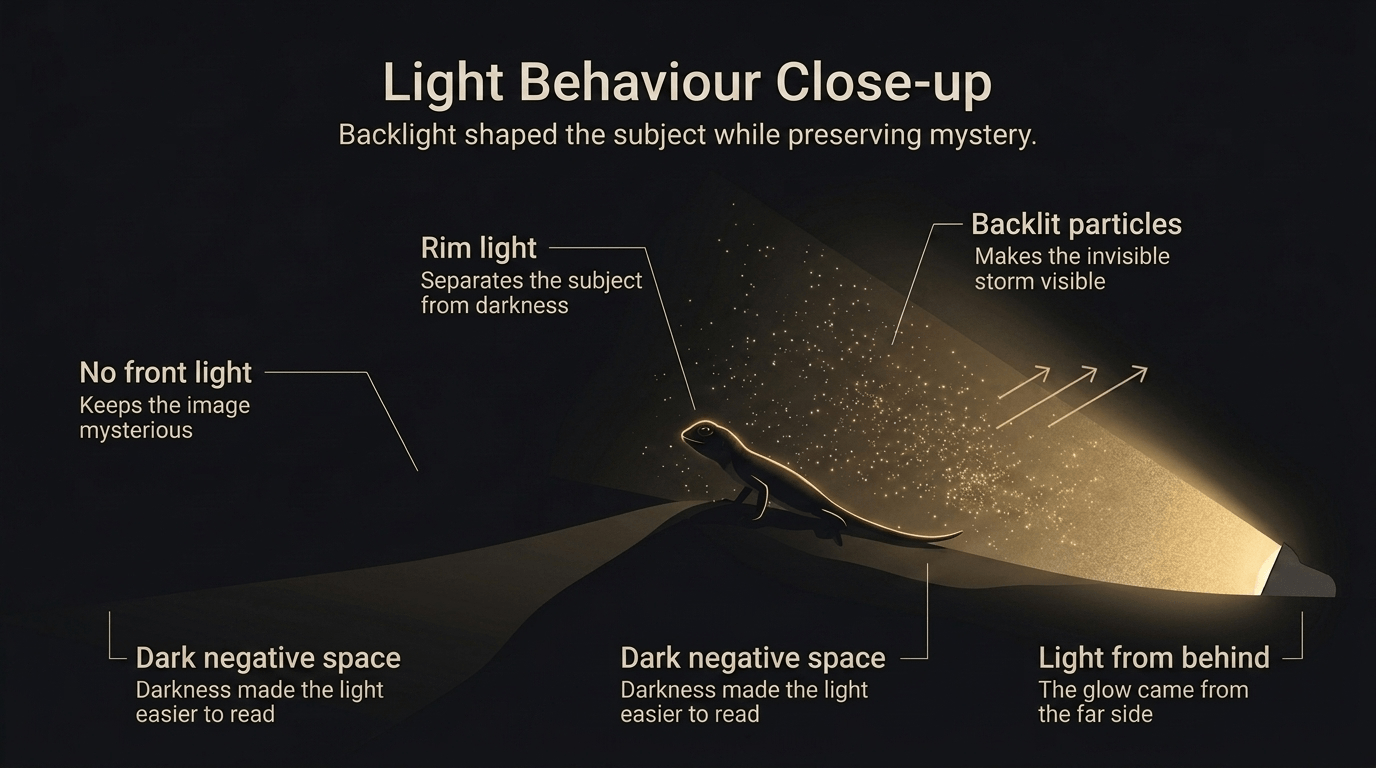 The agama is placed low in the frame, allowing the dark negative space and backlit sand to create scale, silence, and tension.
Using the Land as Part of the Lighting Setup
A small but important detail in this image is the dune itself.
I did not need to lift the light high. The natural rise of the sand placed the subject at the right elevation. By shooting from a lower angle and allowing the light to come from behind the dune, the rim light wrapped around the subject naturally.
This is something I often tell photographers when I coach them: don't think only in two dimensions.
Don't just look at left, right, top, and bottom. Think in depth.
- Where is the subject placed in relation to the land?
- Where is the light coming from?
- Is the ground rising or falling?
- Can the terrain help you hide, shape, soften, or reveal the light?
In this case, the dune was not just a background. It was part of the lighting design.
What Photographers Can Learn From This Image
There are a few practical lessons from this frame that apply beyond this specific situation.
1. Negative Space Is Not Empty Space
Empty space can carry emotion. It can create calmness, tension, isolation, scale, or silence.
When composing, don't always rush to fill the frame. Let the subject breathe. Let the environment speak. Sometimes the space around the animal tells us more than the animal itself.
2. Backlight Can Create Drama Without Showing Everything
Backlight is not about perfect detail. It is about impression.
A rim of light, a glowing edge, or a lit-up atmosphere can make even a familiar subject feel cinematic. This works especially well with dust, mist, rain, fog, snow, or sand because the air itself begins to catch light.
3. Small Subjects Can Create Big Photographs
A subject does not always need to dominate the frame to feel important.
When a small animal is placed carefully inside a vast environment, the photograph can speak about scale, vulnerability, survival, and belonging. I have written more about that choice, the whole animal or the fragment, in the telling detail.
In this image, the agama is physically small, but visually powerful because the composition gives it meaning.
4. Terrain Can Solve Creative Problems
The natural elevation of the dune helped shape the image. It gave the subject separation and allowed the light to work beautifully from behind.
Before changing gear, changing settings, or forcing a setup, look at the land. Often, the environment already has the solution.
5. Difficulty Can Become Part of the Image
The sandstorm made everything harder.
But it also made the photograph stronger.
As photographers, we often wait for perfect conditions. But perfect conditions do not always create memorable images. Sometimes, drama comes from discomfort. Sometimes, the challenge becomes the character of the photograph.
Beyond Settings
For those interested in the technical side, yes, settings matter. Light placement matters. Exposure matters. Timing matters.
But this photograph was not made by settings alone.
It was made by reading the scene.
- By seeing how the storm interacted with the light.
- By understanding how a small subject could hold attention inside a large dark frame.
- By using the dune, not fighting it.
- By waiting for posture, mood, and movement to come together.
That is where wildlife photography becomes more than documentation. It becomes visual storytelling.
Final Thought
When I look at this photograph, I don't just remember the final frame.
I remember the wind. The sand hitting the face. The effort of protecting the equipment. The difficulty of seeing anything clearly. The small moment of noticing the agama. The quick decision to align the camera, subject, and light before the scene changed.
And I remember how unlikely it felt.
A tiny agama.
A dark desert.
A storm moving through the night.
A few seconds of alignment.
Some images are special because of how they look. Some are special because of what it took for them to exist.
For me, Against the Storm is both.
The frame hangs with its siblings in the Light chapter of the portfolio, where the light itself does the storytelling. And the dunes themselves sit inside Desert National Park; the dossier covers when and how to work them.